
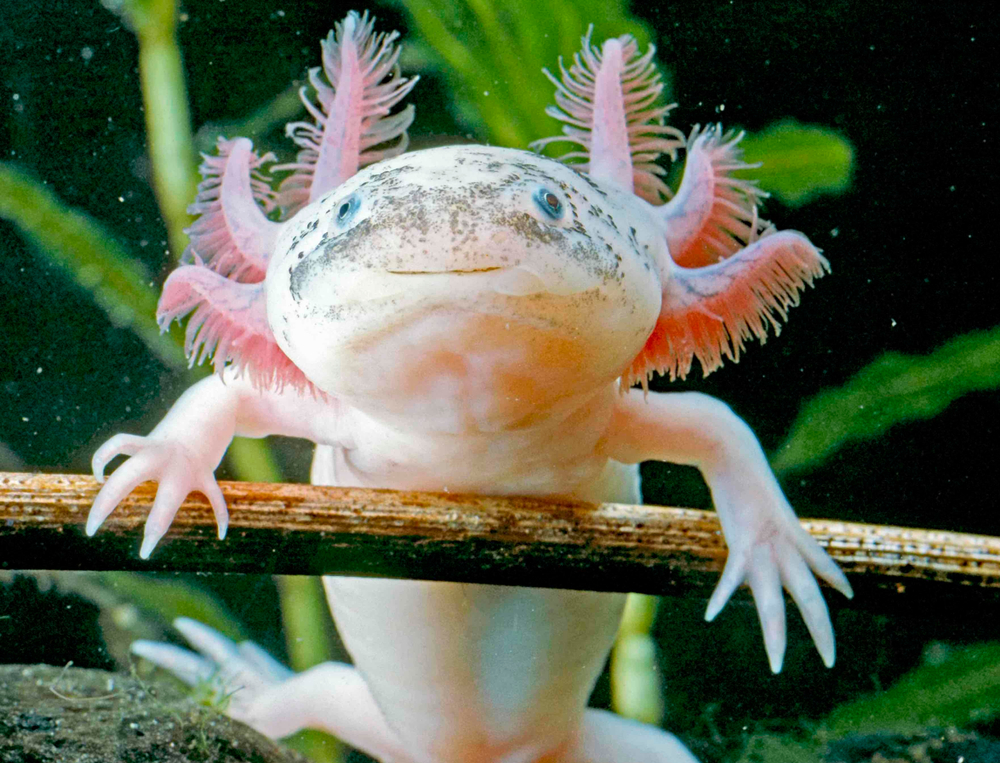
One of the endangered species is the “Mexican walking fish.” But it is on the edge of decline because of the loss of one of its natural habitats, Mexico’s Lake Xochimilco. The population of the lake has shrunk dramatically since the early 2000s. Conditions just got worse, though. While it is known as the “Mexican walking fish,” or the axolotl, it is a sort of salamander rather than a fish. The amphibian, with both gills and lungs, remains in its larvae state throughout its existence.
About axolotls
On average, axolotls can grow to a length of 9 inches (20 centimeters), but some might grow to a length of up to more than 12 inches (30 cm). The salamanders live in captivity for 5-6 years on average, but some live for up to 17 years. Axolotls are usually killed by the Aztecs for their food and are still being eaten in Mexico today. Thanks to their easy care and charisma, they have become one of the most popular pets in the world too. Extraordinary regenerative abilities of the creatures have made them an exciting concept of study for scientists.
The features and purpose of Mexican Walking Fish
- The axolotls live at the lake bottom and rarely venture out. The fact that it can regenerate every part of its body is among its more unique features. This contains both the heart and the brain. Such characteristics make the axolotl an essential subject for regeneration research.
- Scientists have tried to study their capacity for regeneration in the hope of trying to replicate it for human regeneration. The process, though, is rather complicated. Even if regeneration is not possible, studying the axolotls’ genes and abilities may help in the development of alternative healing therapies.
Are the axolotls at risk?
The International Union for Nature Conservation considers that axolotls are critically endangered species, and their population is declining. Surveys conducted in 1998 and 2008, it is found that the population density had fallen from about 6,000 to 100 individuals per square kilometer.
The pollution is particularly harmful to the species. Poor waste controls and rising tourism in Mexico City mean that garbage, heavy metals, chemicals, and high levels of ammonia from treatment plants that block the canals where salamanders are living. They can only live in pure freshwater, as in Lake Xochimilco, and the slow pollution of the lake has led to habitat loss. Recent studies have shown that apart from being polluted, the lake is full of oxygen-depleting plants and algae.